As FY27 gets underway, technology leaders are operating in a very different environment than they did even 12 months ago. AI has moved from experimentation to operational reality. Cyber resilience has become a board-level concern, and the compliance frameworks organisations have relied on for almost a decade are beginning to change.
While new technologies continue to emerge, the biggest change isn't the technology itself but how organisations are expected to govern it, secure it, and demonstrate the value it delivers.
The organisations that succeed in FY27 won't necessarily be the fastest adopters. They'll be the ones that build resilience, make better investment decisions, and create the governance needed to scale with confidence.
These are five of the most important trends shaping technology strategy across Australian organisations throughout FY27.
1. Cyber resilience becomes a business capability
Cybercrime continues to challenge Australian organisations, with cybercrime reports, hotline calls, and the average cost of incidents all increasing over the past financial year. Breach notifications tell a similar story, with malicious or criminal attack remaining the leading cause and human error continuing to account for more than one-third of reported incidents.
The OAIC's January to June 2025 data recorded 532 notifiable data breaches, with malicious or criminal attack remaining the largest cause and human error continuing to account for more than a third of notifications.
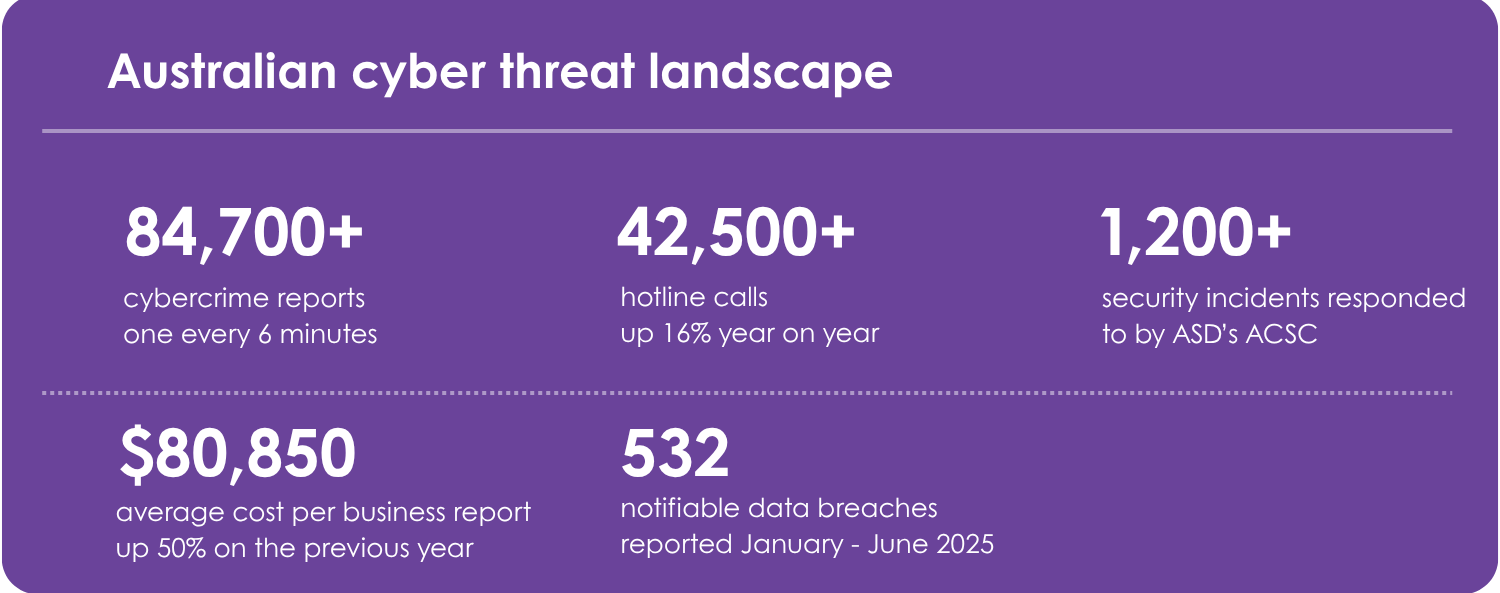
Source: ASD Cyber Threat Report 2024-25
These figures reinforce a broader shift in how organisations are approaching cyber risk. Rather than investing in isolated security controls, they're increasingly focusing on operational resilience. This is particularly important for organisations operating critical infrastructure and essential services, where cyber incidents can disrupt operations, impact public confidence, and affect service continuity, not just data security.
Why identity matters
ASD data shows compromised credentials have overtaken malware as the most common way attackers gain initial access in incidents where data was encrypted for impact. Among the most serious incidents responded to during the year, 42% involved compromised accounts or credentials. OAIC data tells a similar story, with phishing, compromised credentials, and brute-force attacks remaining the leading causes of notifiable data breaches.
Zero Trust has matured from a strategic concept into a delivery priority. Privileged access management, conditional access, MFA resilience, SaaS visibility, and regular access reviews are increasingly becoming the controls organisations rely on to strengthen resilience. As AI introduces another layer of identity, the same authorisation questions that apply to people now apply to autonomous agents as well.
Boards want evidence that controls work, incidents can be contained quickly, and recovery plans have been tested. Success is increasingly measured by how quickly organisations can detect, respond, and recover, not simply how many controls they have deployed, with identity increasingly the control that determines how effective everything else is.
2. AI enters its governance era
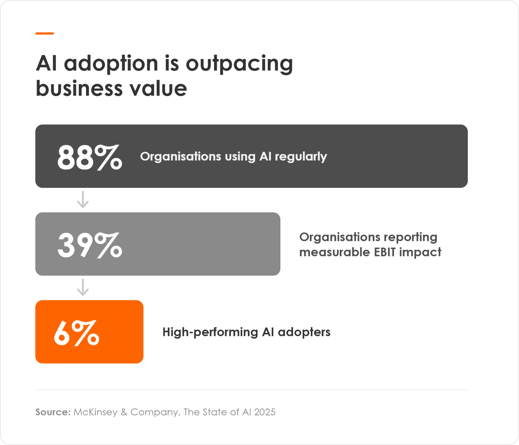
FY27 marks the point where AI enters its governance era. McKinsey's State of AI 2025 found that 88% of organisations now use AI in at least one business function and 62% are experimenting with AI agents. Yet only 39% report measurable EBIT impact and just 6% qualify as high performers, creating significant enterprise value.
The challenge is no longer whether to adopt AI but establishing the governance, accountability, and data foundations that allow it to scale safely. Organisations are asking how AI decisions are monitored, how risk is managed, and where human oversight remains essential. The organisations creating the greatest value from AI are building governance alongside innovation rather than treating it as an afterthought.
The organisations creating the greatest value from AI are building governance alongside innovation rather than treating it as an afterthought.
3. Operational resilience replaces compliance
Compliance remains important, but the baseline itself is being rewritten. On 24 June 2026, the Australian Signals Directorate confirmed it will retire the Essential Eight over the next two years, replacing it with a broader "Essentials" series covering enterprise IT, cloud, operational technology, and, potentially, agentic AI.
The announcement marks the biggest change to Australia’s cyber security baseline since the Essential Eight was introduced in 2017. More importantly, it signals a broader change in how cyber resilience is being assessed. Rather than relying on a fixed, prescriptive checklist, the new framework places greater emphasis on security outcomes and intent, recognising that modern environments are increasingly cloud-based, AI-enabled, and more complex than they were a decade ago. Read our take on what this means for security leaders.
Australia's Cyber Security Strategy and APRA CPS 234 reinforce the same direction of travel. Boards are increasingly expected to demonstrate that controls are operating effectively, incidents are managed appropriately, and recovery capabilities have been tested, rather than simply reporting against a maturity framework.
This is also changing where organisations focus their investment. Identity-first security, Zero Trust architectures, and privileged access management are becoming foundational because they underpin everything from cloud security to AI governance. Rather than treating identity as a standalone security project, organisations are increasingly viewing it as the control layer that enables resilience across their broader technology environment.
Organisations that continue treating compliance as the finish line will find themselves adapting to a fundamentally different regulatory landscape. Operational resilience is becoming the new benchmark.
4. Cloud becomes an optimisation strategy
For much of the past decade, cloud strategy has centred on migration. In FY27, the conversation is shifting towards optimisation. Organisations are looking beyond where workloads run and focusing on how cloud investments improve resilience, support AI, strengthen governance, and deliver better business outcomes.
Gartner's latest forecast puts worldwide information security spending at US$244.2 billion in 2026, up 13.3% year on year, with cloud security the fastest-growing subsegment at close to 29% growth. In Australia specifically, Gartner forecasts organisations will spend more than AU$7.5 billion on information security in 2026, an increase of 9.5%, driven in large part by the security demands of rapid AI adoption.
Leaders are asking how cloud investments support AI, improve resilience, reduce cost, and strengthen governance. Hybrid architectures, disaster recovery, and cost optimisation are becoming central to infrastructure strategy, particularly as AI workloads introduce new cost and architectural complexities not present in earlier cloud migration cycles.
The strongest cloud strategies are focused on extracting more value from existing investments rather than simply migrating more workloads.

5. Technology investment becomes outcome-led
Budget pressure continues to shape technology decisions. According to PwC's Global Digital Trust Insights, organisations continue to prioritise cyber resilience, security automation, and managed services while applying greater scrutiny to technology investment. Skills shortages continue to influence buying decisions, increasing demand for specialist partners and outcome-led services.
Organisations are increasingly favouring targeted initiatives with clearly defined outcomes over broad transformation programs.
Technology leaders are increasingly expected to demonstrate commercial outcomes alongside technical success, and to show that new investment, particularly in AI, is matched by proportionate investment in governing and securing it.
Organisations that prioritise measurable value, governance, and resilience will be better positioned than those pursuing technology for its own sake.
What it means for the year ahead
Taken together, these trends point to a common direction. FY27 is less about adopting the next technology and more about proving existing investments create sustainable business value.
Technology will continue to evolve. AI capabilities will mature. Cyber threats will become more sophisticated. Cloud environments will grow more complex, and the regulatory landscape will continue to evolve.
The organisations that gain the greatest advantage will not be those chasing every innovation. They will be the ones building the governance, resilience, and operational maturity that allow innovation to scale with confidence.
For technology leaders, FY27 presents an opportunity to strengthen the foundations that support long-term growth. Organisations that invest in governance, resilience, and operational maturity will be better placed to respond to whatever comes next.