What is Microsoft 365 E7?
Microsoft 365 E7 is Microsoft’s highest enterprise licence tier for organisations that are already using AI at scale and need consistent governance across productivity, identity, security, and AI-driven processes.
It combines Microsoft 365 E5, Microsoft 365 Copilot, the Microsoft Entra Suite, and Agent 365 into a single licence. Its role isn’t to introduce new AI capabilities, but to bring clearer structure, visibility, and control as AI becomes part of everyday work across teams.
Microsoft 365 E7 isn’t required to use Copilot. It becomes relevant once AI adoption is widespread, and managing it consistently becomes more complex.
Why Microsoft 365 E7 is being considered
AI tools are now common across most organisations, but how they’re managed often varies.
Adoption usually starts with individual teams addressing immediate needs. Over time, those tools become embedded in daily work, while governance, access controls, and oversight evolve unevenly. As usage expands, these inconsistencies become harder to manage.
Microsoft 365 E7 is designed for organisations that have reached this stage. Rather than focusing on experimentation, it brings existing Microsoft capabilities together under a single enterprise model.
What Microsoft 365 E7 brings together
Microsoft 365 E7 brings together capabilities that are often deployed separately across productivity, AI, identity, and security.
Building on Microsoft 365 E5, it combines tools such as Copilot and advanced identity controls into a single environment, reducing the need to manage them separately.
General availability started May 1, 2026, with pricing set at $99 per user per month (approximately $1,188 per year), bringing together E5 capabilities, Copilot, and Agent 365 within a single licence.
It’s intended for larger organisations moving beyond early AI experimentation and looking to manage AI-driven processes more consistently across teams.
Microsoft positions Microsoft 365 E7 as a combination of these core components:
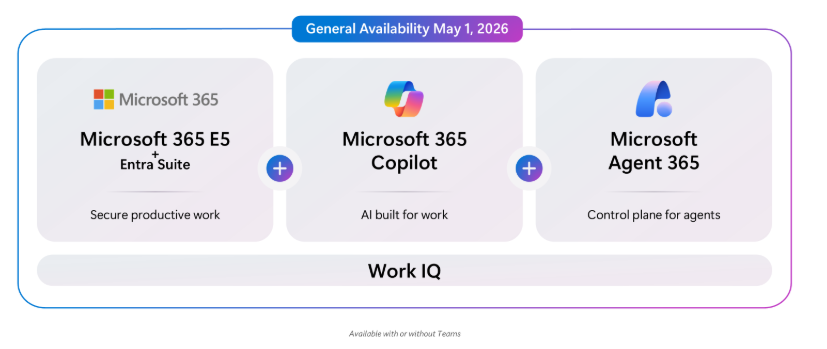
Source: Microsoft, overview of the core components included in Microsoft 365 E7.
Where AI adoption often becomes difficult to manage
AI adoption rarely follows a single, organisation-wide plan.
Some teams introduce Copilot to assist with drafting and summarisation, while others focus on automating operational tasks. Each decision makes sense on its own, but over time, this creates differences in how access is configured and how outputs are produced.
Common challenges include:
-
-
Differences in data access between teams
-
Inconsistent outputs driven by tool configuration
-
Limited visibility into how AI interacts with business data
-
Unclear responsibility for oversight and risk
-
These challenges often become more visible as organisations move beyond initial rollout. Organisations still progressing through Copilot adoption often encounter issues around governance, data readiness, and user enablement before E7 becomes a practical consideration. These are explored further in our guidance on navigating Copilot adoption challenges.
As AI moves beyond assisting individuals and begins interacting directly with systems and workflows, identity and data governance become increasingly important.
How Microsoft 365 E7 addresses these challenges
Microsoft 365 E7 is designed to address the coordination gap that appears as AI usage expands.
By aligning AI tools, identity controls, security services, and automated processes under a single model, E7 reduces fragmentation. AI-driven activity is governed in the same way as users and applications, rather than operating alongside them.
This becomes more important as AI-driven agents begin running workflows or updating systems. These activities require the same visibility, access controls, and auditability expected of other enterprise services.
Agent 365 supports this by bringing AI-driven processes under established Microsoft 365 governance rather than treating them as separate tools.
In many of the environments The Missing Link works with, this is where the focus shifts from what AI can do to how it’s being managed across the organisation.
Microsoft 365 E7 vs Microsoft 365 E5
Microsoft 365 E5 already provides a strong foundation across productivity, security, and compliance, and for many organisations it remains sufficient.
Microsoft 365 E7 builds on E5 by bundling Copilot, Agent 365, and expanded identity capabilities into a single licence. It becomes relevant when these components are already in use together or planned as part of a broader AI approach.
E7 isn’t an add-on. It’s a separate enterprise tier, similar to how E5 sits above E3. Capabilities that might otherwise require individual licensing are included under one agreement.
For organisations managing multiple add-ons, this can simplify licensing and renewals. For others, E7 is typically considered part of standard contract cycles.

When Microsoft 365 E7 makes sense
Microsoft 365 E7 becomes relevant when AI is embedded in day-to-day processes rather than isolated experimentation. It’s best suited to organisations that are already:
-
-
Using or scaling Microsoft Copilot
-
Managing complex identity, security, or compliance requirements
-
Embedding AI into core business workflows
-
Operating primarily within a Microsoft-based environment
-
E7 is most useful when multiple teams rely on AI in different ways, and bringing those differences under control has become difficult.
Where AI adoption remains limited, tightly scoped, or exploratory, E7 is often premature. In these cases, the focus is better placed on strengthening governance, data readiness, and user enablement before introducing another enterprise licence tier.
The decision depends less on organisational size and more on maturity. E7 becomes valuable when the challenge shifts from proving AI’s value to managing it responsibly at scale.
Preparing for Microsoft 365 E7
Microsoft 365 E7 builds on existing foundations rather than replacing them.
Before adopting, organisations should review identity and access controls, data governance models, defined AI use cases, and internal guidance for teams.
Microsoft outlines these prerequisites in its Copilot setup guidance, reinforcing the importance of readiness before scaling AI across the business.
In one university environment we’ve supported, this meant introducing structured training and governance alongside Copilot rollout to ensure usage was consistent from the outset, rather than trying to correct it later.
E7 strengthens what’s already in place. It doesn’t resolve governance gaps on its own.
Where Microsoft 365 E7 fits
Microsoft 365 E7 typically comes into consideration once AI is already part of how work gets done and the challenge shifts to managing it across the organisation.
For some organisations, that point has already arrived. For others, the priority is still building the right foundations before scaling further.
At The Missing Link, we usually start by reviewing how AI is being used across the environment before making any decisions around platforms like E7.
If you’d like a clearer view of where your organisation sits, we can help you assess your current environment and next steps.
FAQs