Part 3 of a three-part series based on a session by Ruchit Deshpande, The Missing Link's Security Solutions Director at Tenable ExposureCon, "Operationalising CTEM," on what it really takes to operationalise exposure management and reduce measurable cyber risk.
Parts 1 and 2 of this series have been about the model. Part 3 is about what happens when you run it.
By the time we first sat down with the organisation, a large healthcare provider was carrying more than 10,000 high and critical findings, spread across multiple security platforms and dashboards that didn't talk to each other. The volume of alerts had already exceeded what the patch management team could realistically remediate. The mix of internet-facing and internal assets only compounded the problem: the findings themselves offered almost no insight into business criticality, exploitability, ownership, or what a compromise would mean for patient care. Prioritisation defaulted to technical severity, because that was the only context available.
Key takeaways
-
-
Exposure management reduced the number of findings requiring immediate action, not just the raw finding count.
-
Business context turned more than 10,000 findings into a prioritised, three-digit remediation program.
-
Automated ownership cut critical remediation from six months to 3–7 days.
-
The result was measurable risk reduction, not just better reporting.
-
-png.png?width=1600&height=900&name=Exposure%20Visibility%20Before%20After-selection%20(1)-png.png)
Figure 1: From more than 10,000 findings scattered across disconnected tools to one correlated, prioritised view: business context and correlation turn scanner, cloud, identity and endpoint data into a single actionable feed.
Why doesn't more scanning fix a problem like this?
More scanning just finds more of the same. The organisation wasn't short on findings. It was short on the context needed to tell which of those findings mattered.
That's where The Missing Link started, not with more tooling, but with a strategic advisory engagement focused entirely on establishing business context across the asset landscape. That meant identifying and classifying the business services that mattered, mapping the assets that supported them, and running an exposure impact assessment to understand which systems represented the greatest risk to operational resilience and patient care.
Only once that asset hierarchy and business context existed did the technology layer go in. We implemented a broader exposure management approach using Tenable, integrating security telemetry from adjacent platforms including cloud security, and correlating vulnerabilities against asset criticality, cloud exposures and business context.
Implementing Tenable and pulling in that telemetry is the easy half. Building the exposure management program is the harder one: the correlation logic, the de-duplication rules, the prioritisation model that turns raw findings plus business context into a single, actionable view of risk. That's the part that took real work, and it's also the part most organisations skip, which is exactly why they end up back where this one started.
What does an exposure management program deliver?
The first thing everyone noticed was clarity, not fewer vulnerabilities. What had been tens of thousands of isolated findings became a prioritised, three-digit inventory of the exposures that were genuinely business-relevant. That's not the same as ignoring the rest. It's recognising that not every finding deserves the same response and building a program that can tell the difference.
The second part was making sure that prioritised list turned into action. We integrated the program with ServiceNow so tickets and remediation workflows went straight to the people accountable for the affected assets, automatically.
That closed the gap that kills most programs: the handoff between "we know what matters" and "someone is actually fixing it." Clear ownership, tracked SLAs, and a direct line from validated exposure to accountable asset owner meant prioritisation finally translated into action.
The organisation reduced its remediation backlog from roughly six months of accumulated work to a 3–7-day cycle for exposures, and it wasn't because the team started working faster. It was because, for the first time, they were only working on what mattered, and everyone involved knew exactly whose job it was to fix it. Not every fix needed patching; some exposures were mitigated by compensating controls such as segmentation.
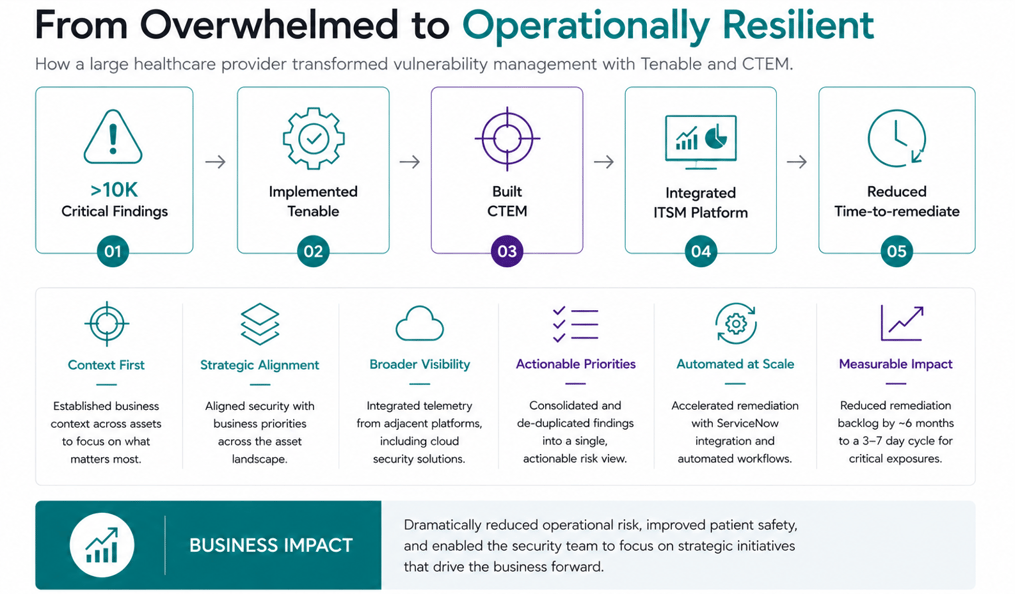
Figure: How a large healthcare provider transformed vulnerability management with Tenable and CTEM: from more than 10,000 critical findings to a 3–7 day remediation cycle.
How did a six-month backlog become a 3–7-day cycle? Not by adding another vulnerability scanner, but through a combination of things:
-
-
Establishing business context before touching the technology
-
Correlating findings with business risk, not just technical severity
-
Prioritising exposures instead of counting vulnerabilities
-
Assigning clear remediation ownership through automated workflows
-
Measuring exposure reduction over time, not just tickets closed
-
The real outcome went beyond a shorter remediation backlog. It was a measurable shift from vulnerability management to exposure management, and for the first time the security team could answer the question every board eventually asks: are we becoming harder to attack?
Exposure management delivers better outcomes by combining business context, prioritisation, workflow automation and continuous validation into one operating model that reduces measurable business risk.
What does this mean for your own program?
Sequence matters more than tooling here: agree what matters first, build the operating model around that answer, and only then bring in the technology, so what you end up with is a validated, owned remediation queue instead of a spreadsheet of counts.
If your organisation is sitting on a backlog that looks anything like this one did, and you're not confident your highest-priority findings represent your highest business risk, a Threat Validation Workshop is a practical place to start.
New to this series? Read Part 1: Why vulnerability management isn't reducing cyber risk, or Part 2: Why exposure management programs stall, and how to operationalise them.