Identity & Access Management Services

Control who gets in. Reduce the risk of what they can do.

When to consider Identity & Access Management

Most organisations don't realise how exposed their identity environment is until something goes wrong.

You should consider an IAM program if you are: 

Moving to cloud or hybrid environments

Strengthen access controls across modern infrastructure. 

Managing privileged or high-risk access 
Reduce exposure by controlling and monitoring elevated access. 
Preparing for compliance requirements 
Align identity controls with security and regulatory frameworks. 
Supporting remote or third-party access

Secure access for distributed teams and external users. 

Three capabilities. One outcome.
Reduce identity risk. Strengthen access controls. Support modern security architectures.

Governance & Access Controls

Governance & Access Controls

Build consistent identity controls across users, applications, and infrastructure, with clear visibility of who has access to what, and why.

Includes:
  • IAM strategy and roadmap
  • Role-based access controls
  • Single Sign-On implementation
  • Policy enforcement
  • Identity lifecycle management
Privileged Access Management

Privileged Access Management

Protect your most critical accounts and reduce the impact of credential compromise through structured PAM controls.

Includes:
  • Privileged account discovery
  • PAM implementation
  • Session monitoring
  • Credential vaulting
  • Privileged account governance
Identity Security Review

Identity Security Review

Assess your current identity risk posture and align access controls with security and compliance requirements.
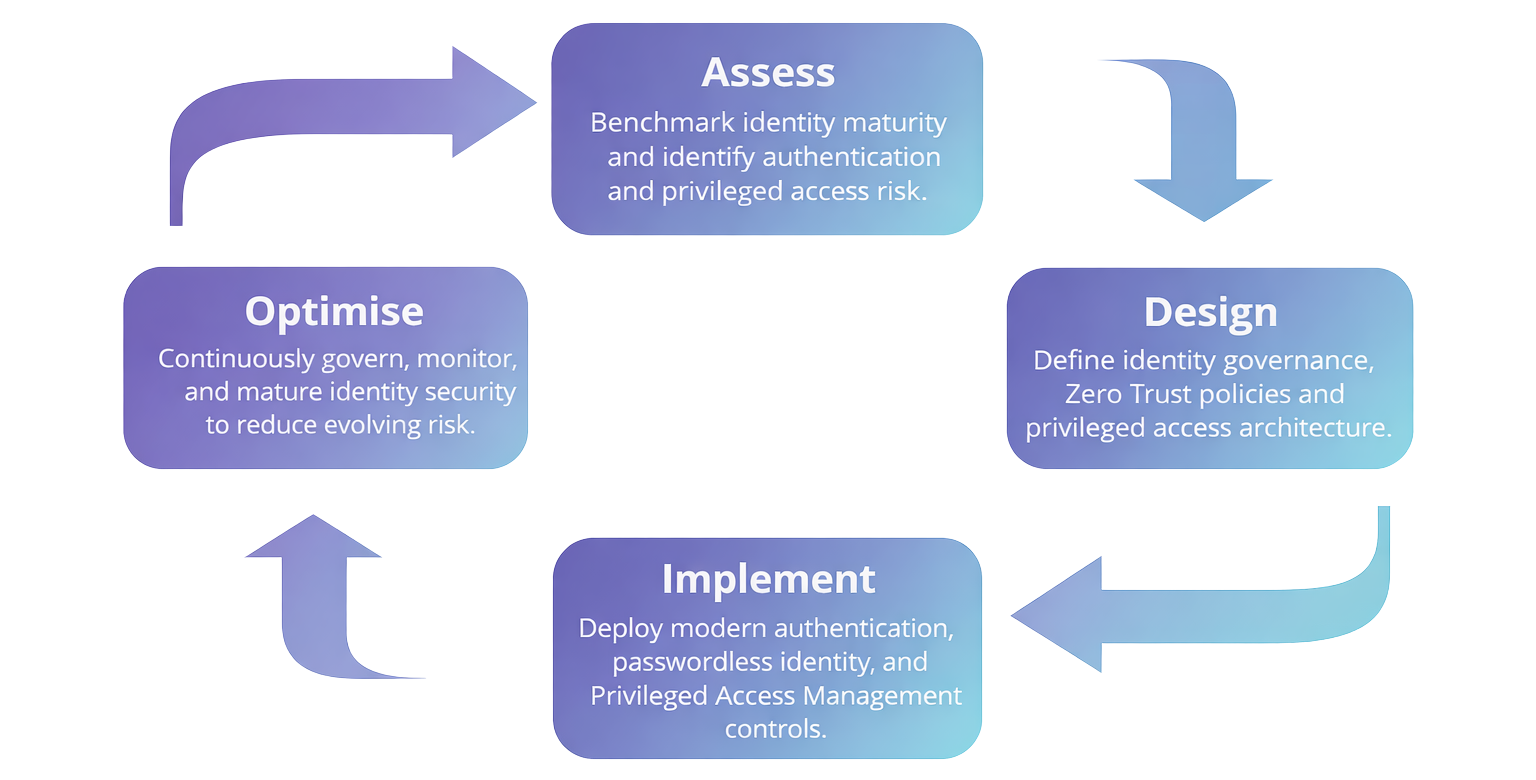
Includes:
  • MFA and conditional access review
  • Privileged account assessments
  • Identity governance assessments
  • Access review programs
  • Security control recommendations

Identity & Access Management benefits

Clear visibility of identity risk

Identify authentication and privileged access gaps to support confident, risk-informed decisions.

Structured findings, prioritised action

Receive structured findings and prioritised recommendations with minimal operational disruption.

Improved containment capability

Reduce lateral movement through stronger authentication and enforced least-privilege controls.

Stronger compliance defensibility

Demonstrate structured identity governance aligned to enterprise risk and audit requirements.

Future-ready access architecture

Prepare securely for AI adoption and evolving digital environments.

Identity & Access Management insights

The modern IAM stack – Tools that power resilient Identity Security

View

Zero Trust starts with identity: How to align IAM with your ZTNA Strategy

View

Is your IAM strategy holding you back? Why Identity is the key to cyber resilience

View

Why partner with
The Missing Link?

Strategic cyber security advisor with deep identity specialisation
Strategic cyber security advisors
Specialists in authentication and access governance
Local Australian expertise backed by global Infosys scale
Contact us today

CREST-certified organisation

CVE Numbering Authority

ISO 27001-aligned expertise

Long-term partnership mindset

Request an Identity & Access consultation

Reach out to us today.

Frequently asked questions

What is Identity & Access Management (IAM)?

Identity & Access Management (IAM) is a security framework that ensures the right individuals have appropriate access to systems, applications, and data at the right time.

The Missing Link provides Identity & Access Management services across Australia, helping organisations strengthen authentication, enforce least privilege, and support Zero Trust architectures. 

Is multi-factor authentication enough to prevent phishing?

Multi-factor authentication significantly reduces risk, but not all methods provide the same level of protection. Modern phishing techniques can bypass traditional MFA through token theft and session hijacking. 

The Missing Link implements phishing-resistant authentication and identity security controls to help organisations reduce the likelihood of credential interception and misuse. 

How does IAM align with Zero Trust?

Zero Trust treats identity as the primary control point. Effective IAM enables continuous verification, least-privilege enforcement, and context-aware access decisions across distributed environments. 

The Missing Link aligns and delivers Identity & Access Management in line with Zero Trust principles, including strong authentication, least-privilege access, and continuous verification across hybrid and cloud environments. This ensures access decisions reflect current risk and behaviour rather than static trust assumptions.

Will implementing IAM impact our current environment?

IAM assessments and transformation initiatives are designed to minimise disruption.

The Missing Link conducts Identity & Access Management health checks and maturity assessments with prioritised, phased recommendations aligned to each organisation’s operational environment and risk profile. 

How does Identity & Access Management reduce breach impact?

When credentials are compromised, attackers inherit existing access. Effective Identity & Access Management limits blast radius by enforcing least privilege, reducing standing administrative rights, and correcting access drift.

The Missing Link strengthens identity governance, so compromised credentials cannot escalate into widespread system exposure. 


How does IAM support compliance requirements?

Identity & Access Management strengthens compliance with frameworks such as CPS 234, ISO 27001, NIST, and the Essential Eight.

The Missing Link designs and implements IAM controls that support regulatory alignment through strong authentication, access governance, and privileged access management. 

How do I get started with Identity & Access Management?

Organisations can begin by assessing their current identity maturity and risk exposure.

The Missing Link offers IAM Health Checks, IAM Maturity Assessments, and Privileged Access Transformation services to help organisations strengthen authentication and access governance across Australia. 

What is the difference between IAM and PAM?

Identity & Access Management (IAM) manages how users access systems, applications, and data across an organisation. It covers authentication, access permissions, user provisioning, and identity governance.

Privileged Access Management (PAM) is a specialised area of IAM that focuses on securing high-risk accounts with elevated privileges, such as administrators, service accounts, and domain accounts.

In simple terms, IAM manages access for all users, while PAM provides additional controls for accounts that can make critical changes, access sensitive information, or administer systems.

How often should access reviews be performed?

Access reviews should be performed regularly to ensure users only retain access required for their current role.

Most organisations review access:

  • Quarterly for privileged accounts
  • Every six months for sensitive systems and applications
  • Annually for standard user access

Additional reviews should be conducted when employees change roles, leave the organisation, or when significant business or technology changes occur.

Regular access reviews help reduce security risks, identify excessive permissions and support compliance requirements.

Can IAM support hybrid and cloud environments?

Yes. Modern Identity & Access Management solutions are designed to support on-premises, cloud, and hybrid environments.

IAM can provide consistent authentication and access controls across:

  • Microsoft 365
  • Azure
  • AWS
  • Google Cloud
  • SaaS applications
  • On-premises systems
  • Remote and hybrid work environments

By centralising identity management, organisations can improve security, simplify user access, and maintain visibility across complex technology environments.

What industries benefit most from IAM?

Identity & Access Management benefits organisations in every industry, particularly those that manage sensitive information, complex user environments, or strict compliance requirements.

IAM is commonly adopted by:

  • Financial Services
  • Government
  • Healthcare
  • Legal
  • Education
  • Critical Infrastructure
  • Professional Services

These organisations often require stronger authentication, privileged access controls, identity governance, and audit capabilities to protect sensitive data and meet regulatory obligations.

Regardless of industry, any organisation that relies on digital systems, cloud services, or remote access can benefit from a mature IAM program.

Case studies

Country Road Group

View

Intrepid Travel

View

South Australia Power Networks

View